Clé 5 sur 20 · にょう · gauche et bas
辶 しんにょう: mouvement
Moving, roads, and distance: going, coming back, near and far.
Elle regroupe 24 des 1026 kanji appris à l’école primaire au Japon.
字源 · POURQUOI CETTE FORME
D’un dessin à 辶
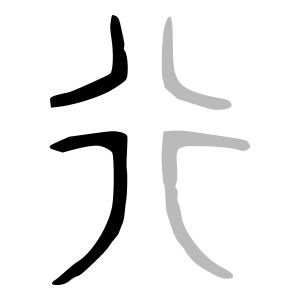 Bronze 金文
v. 1000 av. J.-C.- 彳Aujourd’hui
a step on a road

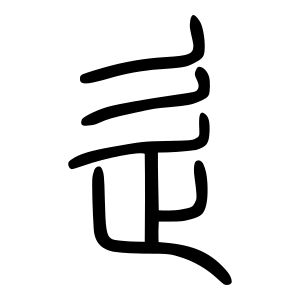 Sceau 篆書
v. 220 av. J.-C.- 辵Aujourd’hui
the two together

Formes anciennes : un exemple attesté pour chacune, tiré du Ancient Chinese characters project sur Wikimedia Commons (domaine public). Les formes variaient beaucoup selon l’époque et le lieu. Touchez une image pour voir sa source.
- 1. The picture
Two older pictures put together: 彳, a step along a road, and 止, a foot. Together they mean walking along a road.
- 2. Brushed into a curve
Writers with brushes ran the strokes together into one quick wave. It now wraps around the left side and bottom of the kanji.
Les origines suivent les explications couramment enseignées. Quand les spécialistes ne sont pas d’accord, nous le disons.
Ce que la famille a en commun
Moving, roads, and distance: going, coming back, near and far.
- 道road-way
- 近near
- 遠distant
- 送escort
Quand l’indice ne marche pas
A few are about choosing or leaving rather than walking.
- 選elect
- 遺bequeath
La famille de 辶, année par année
Tous les kanji de l’école primaire classés sous 辶. Touchez-en un pour voir son sens (en anglais).
2ᵉ année小2 · 5
通
traffic, pass through近
near, early道
road-way, street週
week遠
distant, far
3ᵉ année小3 · 7
進
advance, proceed運
carry, luck送
escort, send追
chase, drive away速
quick, fast返
return, answer遊
play
4ᵉ année小4 · 4
連
take along, lead選
elect, select辺
environs, boundary達
accomplished, reach
5ᵉ année小5 · 6
過
overdo, exceed述
mention, state造
create, make適
suitable, occasional逆
inverted, reverse迷
astray, be perplexed
6ᵉ année小6 · 2
退
retreat, withdraw遺
bequeath, leave behind
Famille : kanji dont la clé classique dans KANJIDIC2 est 辵 (nº 162). KANJIDIC2 © EDRDG, CC BY-SA 4.0.