Radical 17 of 20 · かんむり · top
⺮ たけかんむり: bamboo
Bamboo, and things once made of it: boxes, flutes, brushes, counting sticks.
Heads 15 of the 1026 kanji taught in Japanese primary school.
字源 · WHY THIS SHAPE
From a picture to ⺮
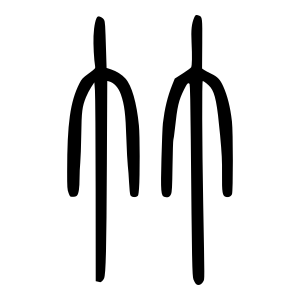 Seal 篆書
c. 220 BCE- 竹Today

Ancient forms: one attested example each, from the Ancient Chinese characters project on Wikimedia Commons (public domain). Shapes varied a lot by time and place. Tap an image for its source.
- 1. The picture
Two bamboo stalks with leaves hanging down.
- 2. Shrunk on top
On top, the stalks shrink to two little clusters of leaves, ⺮, so there is room below.
Origins follow the commonly taught explanations. Where scholars disagree, we say so.
What the family is about
Bamboo, and things once made of it: boxes, flutes, brushes, counting sticks.
- 箱box
- 笛flute
- 筆writing brush
- 算calculate
When the hint fails
笑 (laugh) is under bamboo too. No one is quite sure why.
- 笑laugh
The ⺮ family, grade by grade
Every primary-school kanji filed under ⺮. Tap one to see its meaning.
Grade 1小1 · 1
竹
bamboo
Grade 2小2 · 2
算
calculate, divining答
solution, answer
Grade 3小3 · 5
第
No., residence等
etc., and so forth筆
writing brush, writing箱
box, chest笛
flute, clarinet
Grade 4小4 · 3
管
pipe, tube笑
laugh節
node, season
Grade 5小5 · 1
築
fabricate, build
Grade 6小6 · 3
策
scheme, plan筋
muscle, sinew簡
simplicity, brevity
Family: kanji whose classical radical in KANJIDIC2 is 竹 (no. 118). KANJIDIC2 © EDRDG, CC BY-SA 4.0.